
If you’re new to content creation, then you might be confused about using targeted keywords and using SEO in your content. I’m going to walk you through how to create content for your website and how to research keywords and implement SEO.
You’ll learn in simple terms what SEO is, HOW it works FOR content creation, and WHY utilizing it will help you grow your traffic organically. This is the best strategic advantage you can use to grow your blog or website organically.
The best way to create content with targeted keywords and SEO
So, what does researching keywords and optimizing content have to do with copywriting anyways? It’s super easy to get it confused, and all three have something to do with the other. It’s like relatives. And essentially, You can equate leaving one piece out of content and copy being saltless in a way.
Optimizing your content and copywriting need flavor. Your copywriting is the framework, keywords are the secret ingredient, and optimization is what ultimately gives your copywriting the overall flavor it ultimately needs for your readers.

That’s where the keyword research comes in. That is how you find out what content you write is even relevant for your readers. The keywords also tell search engines that crawl your content what the content is about and how to categorize it on search engines so your readers can find your content – This is called organic referrals, or organic traffic. So when you hear someone say, “Google will reward your efforts with organic traffic”, they mean if your content is optimized right with those keywords, Google will reward you with organic traffic.
Using targeted keywords and SEO isn’t just for Christian business coaches or bloggers. Anyone can utilize SEO and use it to leverage getting traffic to their website. And you should!
It’s HOW you use it that counts. Every page and every post should have searched targeted keywords that your audience is looking for, even on the homepage.
If you want more info on ranking in Google for specific keywords and low competition keywords, and more on optimizing content, I have a free PDF for you to snag and you can find that here.
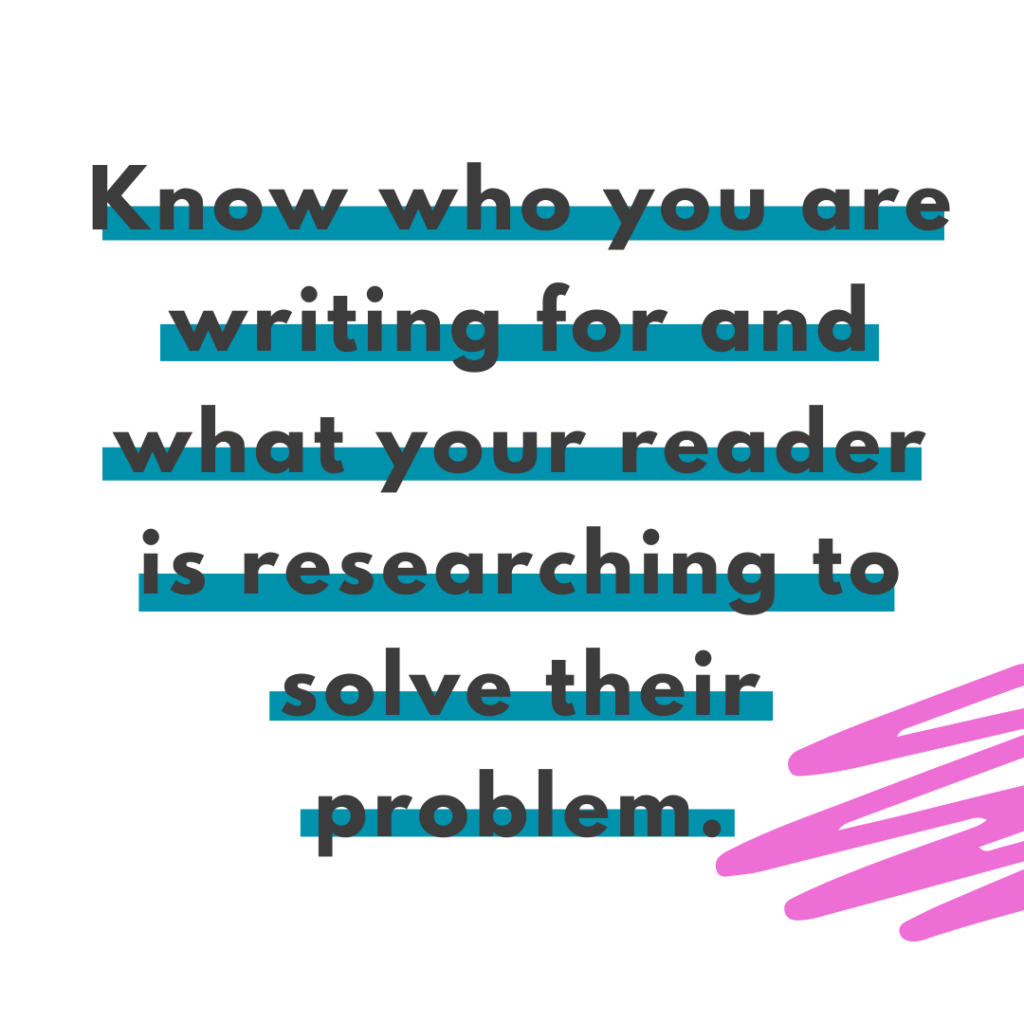
So, the first step before you write any content at all is know who you are writing for, and the second step is to know what your reader is researching.
Getting clarity on those first two steps is super important. Once you know who and what, you can move on to the next steps.
SEO (Search Engine Optimization) in simple terms is…
- Using specific keywords or phrases ( phrases are more than 3 words) that your ideal audience is researching (typing into search engines like Google) so Google understands the kind of content you are writing about and categorize correctly for your readers to find when searching that specific keyword or phrase.
- Targeted keywords and phrases are what you use for your content to be found in search engines.
So you might be asking – “How do I know what my readers are researching”? By researching keywords and doing market research. By going to the actual source and asking your reader, “Hey, when you’re typing into Google about [xyz], what do you type”?
1. Research keywords and key phrases
- Don’t just think of phrases and keywords and type them in thinking that Google will know who your ideal audience is.
- Carefully research targeted keywords or key phrases and verify each one before you include them in your content creation.
- Remember that you are writing for your ideal client. You have to type EXACTLY how they would type their problem into Google.
- Find one main key phrase and one alternate, but make the phrases so they relate to the topic your content is about and include both in your H1 (main title).
2. Where to research targeted keywords and key phrases for content creation
- Ubersuggest – You get 3 searches total on a “free” plan, but can type in 3 phrases each for the 3 searches.
- SEMrush – They offer 10 free searches a day.
- Google Search – By typing in the first 2-3 words in a phrase, the most popular will automatically be shown first. This isn’t definite, but it gives you an idea of what people are searching for.
- Google Suggest and related searches – At the bottom of the search, Google will give you suggestions and related phrases people are searching for.
- Facebook search – In a group, there is a magnifying glass in the upper right corner. You can type in any keyword or phrase and it will bring up the most current and related posts for that specific keyword.
- Pinterest search – This works similarly to Google search. Type the keyword in the search bar and it will populate the most searched keyword. Pinterest also goes an additional step and gives you related searches depending on how popular that keyword is searched. The most popular searched phrases will be at the top of the search in different colors.
- Medium – This is a great website for searching for all different kinds of content.
- Your competitors – Search similar business owners in your niche and find out what kind of keywords they might be using. DON’T COPY! This is purely research to get an idea of what to search for validation.
- Answer the public – This handy tool will tell you all the keywords and phrases people are searching for in the topic you searched for.
How to brainstorm content creation
1. Brainstorm before writing your content out
- First, Know who you are specifically writing for. You can’t write for everyone.
- Are you a typer or a writer? If you’re a writer, and you brainstorm better with a pen in your hand versus staring at a computer screen, utilize that. If you’re a typer, use a Google Doc or other software where you can save your content there. The goal is to cut down on the time it takes you to create content. Staring at a blank cursor on a screen causes more stress and pressure.
- Don’t type your content directly into your site. Have it saved in another place in case someone hacks your website. If you’re using Google Docs, it’s SUPER easy to copy and paste straight from Doc into WordPress or whatever kind of site that you have. (Just sayin’, WordPress is best 😜)
- Type what comes to mind for that specific topic you’re talking about. Just let it flow out. This is where you are truly speak-typing from your heart, and you create a flowy, sound-like-you copy.
- Don’t title your content until after you’ve written it. Create what I call a “title outline” to have a general idea of what you’re going to be writing, but don’t make it an official title until you’ve written your piece completely.
- Edit after you are done completing your content. You are more unlikely to catch misspelled words and make correct edits. Edit your content a day or two after you have written it. You may read it and decide to change certain phrases or sentences that you would have missed if you hadn’t waited to edit it.
- Remember the power of “I” vs “you” – Your readers didn’t come to your website to learn about you. They want to consume your content because it is valuable and educational. Always refer to them instead of yourself when you’re typing. Save the “I” for the About page.
2. Batch keyword research, title outline, and content creation
How awesome would it be if you could just head over to your Google sheet and hand-pick out of your title repository what you wanted to write? In my Google sheet, I have over 100 title outlines. I can go in on my content creation day and pick what pops out at me and just start writing it. The keyword research is already done.
3. Successfully editing content creation
- When you’re editing, you always want to keep in mind if there is a way to shorten what people are reading.
- If content can be made into bullet lists, people love those.
- Use Grammarly to help you edit your content.
- Use great, high-quality photos. Yes, there is Pixabay, Pexels, and Unsplash for unlimited free images, but you are not the only person to travel regularly to these sites. When you’re first starting, keeping the cost down is a priority. But as soon as you can afford to, pay to have branded images done.
- Don’t use PNG images unless it’s necessary not to have a background.
- Always compress your photos before uploading them.
Where to include targeted keywords for content creation to rank well on search engines
- Firstly, If your website is new, or you’ve just started writing out content for your audience, Opt to use keywords that have a very low SEO score.
- Whether you just bought your hosting service or you are working on your website, make it live ASAP. Only bots will come to visit your site. This gives your website an advantage to start aging, and Google favors content from sites that are established.
- Make your H1 titles captivating and click-worthy. Whether it’s an H1, H2, a paragraph, or a blurb… make it count! Write everything with intent and strategy behind it. Don’t let your writing go to waste!
- If using 2 keywords, always use both key phrases in the meta description.
- Put the key phrase in the URL! The URL doesn’t have to be long, just has the keyword in it.
- Use the title in your image description. Don’t just title an image like “girl sitting on a couch on a laptop”. Rename the photo on your computer before uploading it to your site.
What to do after you have shared your content creation
Be prepared to wait. Implementing the power of SEO takes time, but it’s very worth the wait. This is the most strategically intentional long-term goal you can do for your business.
Keep content creation simple!
If you ever find yourself on the struggle content creation bus and just can’t summon creativity, take a break. You can’t force it. If you need some inspiration, read other blog posts or a book, or listen to your favorite podcaster. You would be amazed at how hearing just one phrase will spark a flood of thoughts for your next blog post idea.
You don’t need witty, sophisticated words to attract readers. Your content just needs to be simple, educational, and readable. If you get ideas for content creation that doesn’t fit the current content you are working on, create a notes page in Google Doc and copy and paste the idea there to save it. I’d love to know what takeaways you got from this post. Leave me a comment below!
Hey there skimmer
Wanna listen instead of read? Listen to episode 9 // How to Crush Content Creation With Targeted Keywords & SEO.
CHECK OUT RELATED POSTS
2 Business Assets to Focus on Starting an Online Business
Captivate Your Ideal Clients With Powerful Website Copywriting
How to Validate an Online Business Idea as a Solopreneur!
FIND THE PODCAST: